Die With Zero?
Bill Perkins: 'The point of life isn’t to maximize time or money; it’s to maximize experiences and minimize regrets'

You can earn more money, but you can never recapture time.
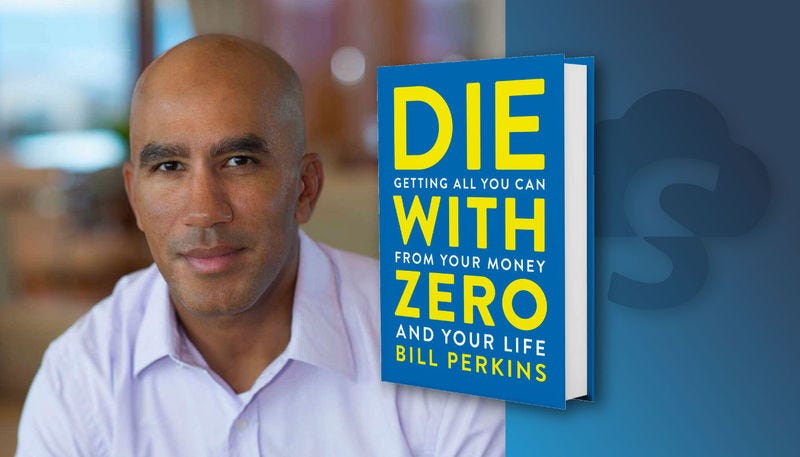
That’s a key takeaway from Bill Perkins’ book, Die With Zero, which has made the rounds in the investment community since its 2021 release. Perkins argues that the business of life “is the acquisition of memories” rather than a higher net worth. He calls them “memory dividends.” He says we should collect as many good memories as we can.
Perkins, a former hedge fund manager, is an avid poker player who has participated in extreme sports such as skydiving and deep-sea diving. He wrote the book to share his philosophy toward saving, spending, and life, encouraging readers to maximize experiences and minimize regrets. He advocates “dying with zero” (dollars) rather than working for 40-50 years, saving, then dying with (presumably) a good chunk of money in the bank.
Writes Perkins: “People are more afraid of running out of money than wasting their life, and that’s got to switch. Your biggest fear ought to be wasting your life and time, not, ‘Am I going to have x number of dollars when I’m 80?’”
For the record, I’m all for living below your means and investing wisely, but I’m also a big fan of Perkins’ life philosophy. He has even said that we don’t need to take his message of “die with zero” too literally - it’s meant to be general guidance, not gospel.
How the philosophy plays out for me, for example: I try to remember that I’ll only be in my 20s a little longer, so I might as well maximize that time traveling, trying new experiences, and so on, before having children and growing older.
Other examples for me: Maybe I'll spend a little more on a flight home so I get an extra day with family instead of banking the savings. I've started saying “yes” to weekend trips I would have talked myself out of a few years ago, reasoning that the money will still be there later but the free weekends with the people I love won't be. Even something as simple as taking a class or trying a new sport/activity falls into this bucket. The cost is small now and the return, in memories and experience, usually gets more valuable with time.
Shared memories
Perkins tells the story of a man who was only 35 when doctors told him he had terminal cancer. When his family received the bad news, his wife quit her job, and they enjoyed the time they had left together. After his death, his wife was thankful for all their final shared memories. This story may sound simplistic and extreme, but it underscores Perkins’ core concept: Our time on Earth is finite. We must spend it carefully. Yet when we think about our limited resources, we sometimes forget about time itself.
As author Morgan Housel points out, “The purpose of life is to experience things for which you will later experience nostalgia.” I love that.

Sum of experiences
One of the book’s main ideas is that your life is the sum of your experiences.
When you’re young, you generally have less money but great health. When you’re older, you have more money but less health, energy, or time. What we might do by default when we’re young (or middle-aged) is save a lot of money for retirement. A challenge is that we could miss interesting experiences we can never try again. Perkins’ point is definitely not to just “YOLO” (you only live once)…it’s to spend money on experiences that might not be there in 10 or 20 years: that trip with your children, for example, that birthday weekend with your friends, or anything else where the window for the experience closes. Basically, anything you might regret.
At the end of your life, you will (hopefully) remember all of your great experiences — not bank account balances or whether you maxed out your 401(k) plan when you were 37.
“The way to truly maximize your life is to live in the moment, enjoying what you have and not worrying about what you don’t,” Perkins writes.
Life energy
What’s the best way to allocate our life energy before we die? Perkins has thought about this question for years.
“Some experiences can be enjoyed only at certain times,” he writes. “Most people can’t go water-skiing in their 90s. Another principle: Although we all have at least the potential to make more money in the future, we can never go back and recapture time that is now gone…So it makes no sense to let opportunities pass us by for fear of squandering our money. Squandering our lives should be a much greater worry. So to increase your overall lifetime fulfillment, it’s important to have each experience at the right age.”
Early inheritance
The book is dotted with examples of “Die With Zero.” One of the more tangible ideas is giving your inheritance out early.
Rather than wait until you die before giving to your children, for example, Perkins makes a compelling case for an early inheritance. Example: Give your children or grandchildren money for a down payment on a home, family trips, or weddings, so you can enjoy the inheritance with them.
Perkins also says not to spend lavishly. Instead, invest in experiences with the people you love, respect, and admire. Otherwise, he argues that the inheritance will likely arrive too late to have a maximum impact on the recipient’s quality of life.
“The purpose of money is to have experiences, and one of those experiences for your kids is time with you. Therefore, if you are earning money but not having experiences with your kids, you are depriving your kids. And yourself.”
Key concepts
Focus on experiences over possessions: Rather than accumulate more stuff, invest in experiences that align with your values and goals. “Don’t fall into the trap of thinking that more is always better. Sometimes less is more, especially when it comes to experiences.”
The value of time: Time is our most valuable resource, so it’s important to use it wisely and prioritize the activities and people that bring you the most joy and fulfillment. “The key to making the most of your life is to make intentional decisions about how you spend your time, money, and resources.”
Be intentional about spending: Create a plan for spending your money and resources, and ensure that it aligns with your values rather than societal norms. That’s a biggie.
Embrace risk: Taking calculated risks can lead to great rewards and experiences. “The most important thing you can do to maximize your life is to figure out what you really want and then go after it with everything you’ve got,” Perkins says.
Love this reminder. Time and money spent intentionally with those we love and care about is how to maximize the joy of living. The "stuff" is nice but does not fulfill us. It's our relationships.